Has the stress of this moment made it hard to think about the opportunities and challenge that exist for your organization right now? Would you like a more straight forward way to facilitate conversations with your board and staff about how to best use organizational resources right now? Trista has created a guide to help you navigate these times. Download the Coronavirus FutureGood Workbook Here.

Virtual Volunteer Opportunities
Are you sick of watching Netflix and eating everything in your house? Are you ready to give back and help communities locally and globally that are dealing with the effects of Coronavirus? Then let’s get virtual volunteering!
Coronavirus Specific Volunteer Opportunities
Call Seniors and Keep them Company ALONE’s Support & Befriending service provides companionship to older people who would like extra social contact through a weekly telephone call.
Contact your neighbors and extended family members. Check in and make sure the people in your life are well and have the supplies they need.
Zoom Trainer. Train Staff, Interns, etc to use Zoom to lead online classes for Homebound Seniors for Selfhelp Community Service's "Virtual Senior Center".
Open Source Mask Sewing Project. Crafty people around the world are making masks as a last resort for hospital workers and anyone else who needs added protection. Check out the Minnesota version of this effort here.
Contest to develop a rapidly deployable mechanical ventilation solution. If you have the technical skills a great challenge now is increasing the number of available respirators, work on this challenge to solve this issue.
Join the U.S. Digital Response for COVID-19 If you have relevant experience (healthcare, data, engineering & product development, general management, operations, supply chain/procurement and more), can work autonomously through ambiguity, and are ready to jump into a high-intensity environment join this effort to help government tech capacity at this critical time.
3D Printers Needed for Coronavirus Supplies. The 3D printing community is rallying and developing new innovations to help with the Coronavirus epidemic.
Help someone that is blind or low vision with everyday tasks. Be My Eyes is a free app that connects blind and low vision people with sighted volunteers for visual assistance through a video call. This is especially important now as many are cut off from essential services and support.
Volunteer with the Crisis Text Line. Crisis Text Line is the free, 24/7 text line for people in crisis in the United States. The service is powered by volunteer Crisis Counselors who work remotely — anywhere with a computer and secure internet connection works.
Check Idealist for new volunteer opportunities. There are new general and Coronavirus specific virtual volunteer opportunities listed everyday.
General Volunteer Opportunities
United Nations Online Volunteering program- The United Nations Volunteers (UNV) programme contributes to peace and development through volunteerism worldwide. Online volunteering allows organizations and volunteers to team up to address sustainable development challenges – anywhere in the world, from any device. Volunteer activities include translation, teaching, design work, and technology development.
Red Cross Digital Volunteer Program When disaster strikes, Digital Volunteers assist the Social Engagement team by:
Monitoring online conversations for disaster-affected people who may need Red Cross help
Sharing important disaster updates and resources through their personal social media accounts
Offering a compassionate voice to people who have been impacted
Smithsonian Transcription Volunteer Become a Smithsonian Digital Volunteer and help us make historical documents and biodiversity data more accessible. Join 14,834 "volunpeers" to add more to the total 516,657 pages of field notes, diaries, ledgers, logbooks, currency proof sheets, photo albums, manuscripts, biodiversity specimens labels that have been collaboratively transcribed and reviewed since June 2013.
Add women scientists to Wikipedia. Only 18% of the 1.6 million biographies in the English Wikipedia are about women. The figure is lower for people tagged as scientists – 16% of almost 150,000 articles. There are now focused efforts to change that.
Join a crowd powered research project. The Zooniverse is the world’s largest and most popular platform for people-powered research. This research is made possible by volunteers — more than a million people around the world who come together to assist professional researchers. Our goal is to enable research that would not be possible, or practical, otherwise.
Proofread a book for an effort to get historical books online. You can help proofreading new eBooks by joining the Distributed Proofreaders team. You will proofread one page at a time, as many as you like, as often as you like. Use the DP forums to communicate with your fellow proofreaders.
Help Harvard Researches Measure Implicit Bias Here you will have the opportunity to assess your conscious and unconscious preferences for over 90 different topics ranging from pets to political issues, ethnic groups to sports teams, and entertainers to styles of music. At the same time, you will be assisting psychological research on thoughts and feelings. Sessions require 10-15 minutes to complete.
So get off the couch and get back on the coach to volunteer virtually.
How Nonprofits & Foundations Can Use Scenario Planning to Prepare for Coronavirus
Communities are facing a lot of uncertainty and fear around the Coronavirus (COVID-19). Nonprofits and foundations have a unique role in creating resilient communities that can weather real or potential health dangers. But the amount of information available can leave nonprofit and foundation leaders overwhelmed and paralyzed with uncertainty about the best path forward. That’s where scenario planning can provide some much needed clarity.
Scenario planning is a structured way for organizations to think about the future. Scenarios are just stories about how the future might unfold and how those future conditions could impact the organization. Scenarios challenge your conventional assumptions and help you deal with times of uncertainty.

Scenario planning is the intersection of organizational strategy, which is the sum of the actions the organization plans to undertake to meet its long-term goals; forecasting, which is using data from the past to estimate future trends; and environmental analysis, which asks that you understand the factors external to the organization that can impact its operations.
Scenario planning is a critical skill for nonprofits and foundations. It allows you to identify a variety of possible futures, and then you can use the best- and worst-case scenarios as planning tools. The Oxford Scenarios Planning Model works well during times of changing outside forces, like now. I’ve created a tool to help your organization think about how Coronavirus might impact your organization or the people you serve. It is intended to help you brainstorm with your staff, board and constituents.

Coronavirus Scenario Planning Tool for Nonprofits
When I have used this tool in the past I used painter’s tape to create 4 quadrants in a highly used conference room. I labeled the quadrants and kept 2 colors of post it notes nearby. Yellow for opportunities and pink for challenges. You brainstorm opportunities and challenges for each of the quadrants. I would suggest keeping the chart up for a least a week to get a wide variety of input. For example, identify a challenge if Coronavirus spreads in your community in regards to your role as an employer. Some ideas might be:
-If schools close, employees will have a hard time securing childcare.
-Staff will need to remote work if social distancing is encouraged.
It will probably be much harder to think of opportunities but some examples for this quadrant might be:
-Organization will develop universal rules about remote work that could strengthen employee satisfaction in the future.
-Organization will develop emergency response protocols that are useful for a variety of emergencies.
Now for foundations:

Coronavirus Scenario Planning Tool for Foundations
Foundations have an additional responsibility to understand how this virus could impact grantees and how they are responding. That could mean un-restricting previous grants so grantees can be nimble and address community needs. It could mean connecting a grantee with an expert resource or it could be as simple as changing reporting dates to give grantees more time to do critical work.
I would encourage you to start thinking about challenges and opportunities and start prioritizing where you can take immediate action. Often there are ideas that show up in all quadrants, start working on those because they will be useful, no matter what the future holds.
Additional Resources
World Health Organization- COVID-19 Updates
Could the coronavirus hit California’s homeless populations? Health officials are worried.
Philanthropy’s Response to the Coronavirus Outbreak
About the author:
Trista Harris is a philanthropic futurist and is an experienced disaster grantmaker. She is the President of FutureGood, a consultancy committed to helping visionary leaders build a better future. She offers consulting and strategy support for nonprofits and foundations that are developing their Coronavirus response strategies. Learn more about those services here.

Using two curves to create your ideal future
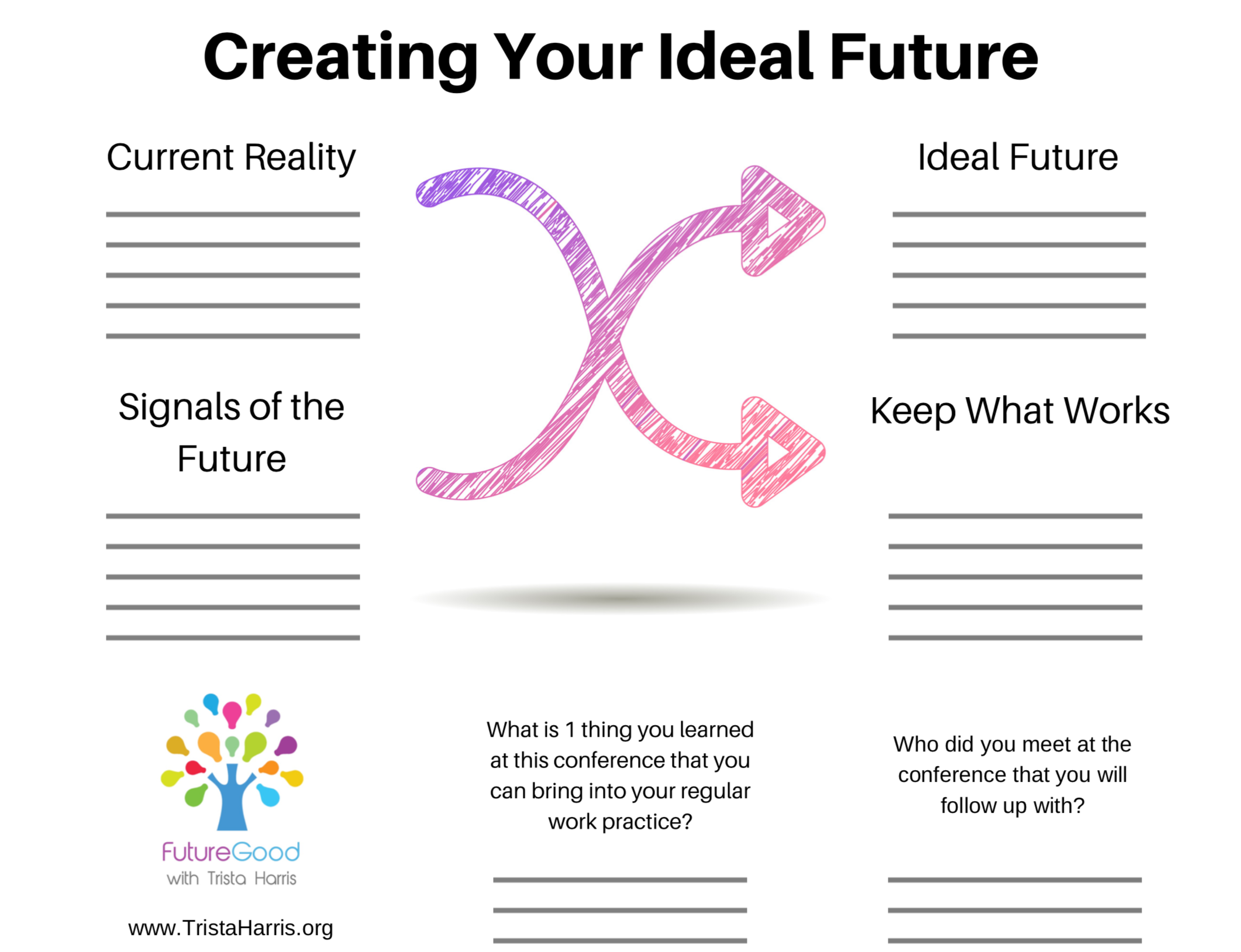
I have been spending this week with a delegation of change makers at 1440 Multiversity. We are learning how to do the work of doing good sustainably. In my session, The Future of Good, I shared the visual below as an idea starter to help participants clarify their vision for their future impact and to understand which parts of that vision live in their current reality and which things have to change for them to get there. Feel free to use this visual as you clarify your own future direction. You can also download your blank copy here. If you are interested in spending time with a group of women learning about how to create your ideal future, check out the FutureGood Women’s Mastermind Retreat. Early bird rates end December 31, 2019.
Trista's 2020 Philanthropy Predictions
Every year, Trista Harris and her team of researchers at FutureGood curate a list of trends that we believe will impact foundations and nonprofits in the coming year. Here are our 2020 predictions.
Institutions examine their impact on the environment. As the climate crisis worsens, foundation will examine how their institutions impact the environment. From eliminating in person meetings that could be conducted via webinar, to divesting from fossil fuels, to adding solar panels to their buildings, to encouraging remote work, and paying for carbon credits when their staff travel, foundations will look deeply at how they can have a positive impact on the environment.
Foundations become more digitally savvy. Foundations will begin to add Chief Digital Officers (CDO’s) who are tasked with leading digital engagement efforts, maximizing the efficiency of grants management systems, financial systems, and relationship management databases. These CDO’s will hire staff and consultants with expertise in automation, to limit the amount of time that staff spend on repetitive duties like checking nonprofit status, updating databases, and managing reporting and instead use that time to deepen relationships in community. Foundations (and nonprofits) that don’t invest in staff in this area will be disrupted externally or internally by a new generation of self-automators.
Funders help defend democracy. As we see a more divided union in the United States and growing instability abroad, foundations will invest more resources to strengthen democracy. From creating spaces for people to come together and discuss solutions to complex issues, to reinvigorating our civics curriculums in schools, to ensuring the safety of elections locally and globally, foundations will have to develop new skills and relationships to have an impact on this critical need. Networks like Philanthropy for Active Civic Engagement will be one of the key places where funders can connect about these issues.
Workplaces support staff during times of rapid transformation. Foundations will begin to think more deeply about employee wellness. The old paradigm of doing good for your career by working in the social sector being enough to protect you from the stresses of work will no longer be enough as foundations become frontline actors in a whole scale transformation of society. Foundations will invest more in employee wellness programs, offer more options for remote work, add more vacation days, and invest in improving their organizational cultures.
A few bonus trends that will impact foundation grantmaking:
Nazis really hate robots. We believe that the recent rise of Nazism is tied to job losses created by artificial intelligence and robots. Because we don’t talk about these fundamental changes to our economy and how quickly they are happening, people have an old story that “immigrants and people of color are taking our jobs”. That is creating a rise in hate. Foundations have a critical role in supporting messaging about changes to the economy and countering hate with their grantmaking.
Universal Basic Income on the map- As we look at job losses from artificial intelligence and robotics, the financial model for work will have to change. Universal basic income sets a floor for everyone, whether they are working or not. This amount is often described as about $12,000 a year. Companies and higher income people are taxed to cover this amount. The newest push for Universal Basic Income is from leaders in Silicon Valley that can see how their products are eliminating workers but they still need customers to pay for their products. Foundations will be on the cutting edge of testing this idea for scale.
Longer lifespan for who? There have been significant advancements in regenerative medicine. Regenerative medicine is about repairing and rejuvenating our bodies. From using your own stem cells to repair effects of things like Alzheimer’s, to 3D printing new organs, to even using the blood of young donors to reverse the signs of aging in older patients, there are a plethora of innovations that have the potential to extend human lifespan. As these new technologies take hold, there will be significant questions about the ever-expanding gaps between the lifespans of the poor and rich. Philanthropy will have a key role in supporting conversations about the ethical use of these new innovations and access for low-income communities.
Equity minded algorithms- A 2019 study published in Science found that an algorithm, widely used by US hospitals to determine how to allocate care for more than 200 million patients, was less likely to refer black people than white people who were equally sick to programs that aim to improve care for patients with complex medical needs. We are just beginning to understand how algorithms are expanding disparities and foundations will begin to take an active role in funding solutions to this growing problem.
About: Trista Harris is a philanthropic futurist and nationally known as a passionate advocate for leaders in the philanthropic and nonprofit sectors. She is also the author of the books How to Become a Nonprofit Rockstar and FutureGood: How to Use Futurism to Save the World. She is a President of FutureGood, a consultancy focused on helping visionaries build a better future.